Autobot
Blaster
Autobot Communications
"It’s the sound and the fury that count."
Loud, warm and fearless, Blaster loves Earth music so unreservedly that he will broadcast it over live Autobot channels, which makes him a liability the moment silence or discipline is what the mission needs.
FactionAutobot
Alt-modeBoombox / cassette deck
Debut1985 . S02
VoiceBuster Jones
WeaponsElectro-scrambler gun . Cassette troops
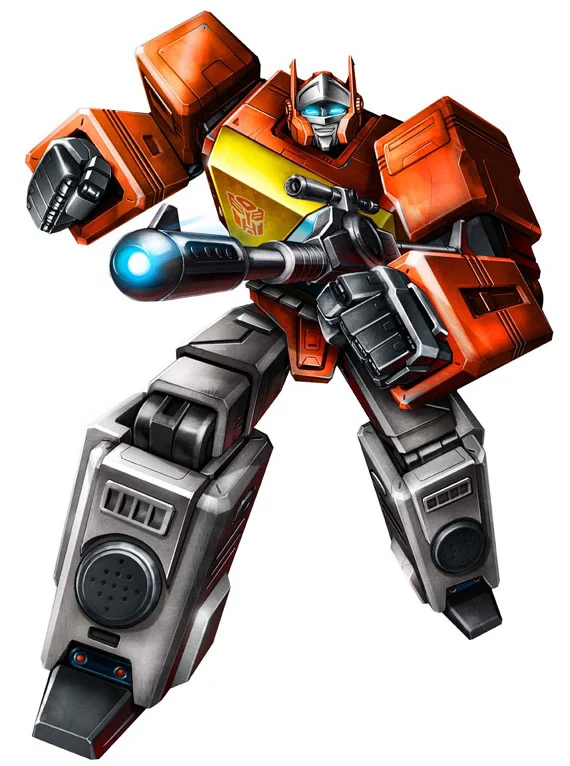
Image via TFWiki (Teletraan I: The Transformers Wiki), used under fan-archive fair use · source
Profile
Blaster is the Autobots' communications officer and their loudest personality, a walking boombox whose tech spec motto is "When the music is rockin, I'm rollin." He finds all Earth music interesting but rock and roll, in his words good, hard and loud, is what sparks his circuits. Buster Jones played him in the cartoon with an easy, warm delivery that made him one of the few Autobots who felt like he actually enjoyed being on Earth.
The music is both his character and his running joke. In "Dinobot Island, Part 1" he cannot tune a station until Grimlock blasts his controls. In "Blaster Blues" he floods the Autobot comm channels with his playlist for the benefit of comrades who did not ask for it, in the process drowning out an emergency transmission from the Helix Observatory and earning a rebuke from Optimus Prime. Captured and welded into place as a trans-scrambler for Megatron's plan to black out Earth's communications, he quietly broadcasts music anyway, which both rallies the Autobots and gives away Megatron's position. Megatron kicks him in the face for it. He is then exiled to the abandoned moon base with Cosmos and promptly gets in trouble for his music again.
His defining conflict is with Soundwave, his exact Decepticon opposite number. "Auto-Bop" gives them their first real duel: Blaster tells Soundwave he has been waiting a long time for this, is driven back by Soundwave's sonic assault, and wins only by jury-rigging the nightclub's own sound system into his speakers. In "The Transformers: The Movie" the two fight by proxy at Autobot City, Soundwave's cassettes striking the transmitter and Blaster answering with Steeljaw, Ramhorn, Eject and Rewind. By season three he is running communications at Autobot City and calls in Sky Lynx to rescue Metroplex's transforming cog.
Abilities and weaknesses
As an AM/FM stereo cassette player Blaster serves as the Autobots' communications centre: he receives radio signals across all frequencies down to power outputs as low as one millionth of a watt, and can transmit up to 4,000 miles. He carries an electro-scrambler gun that disrupts electrical devices, and in "Make Tracks" he jams the control frequency of Megatron's remote-piloted car drones outright. He deploys cassette partners (Steeljaw, Ramhorn, Eject, Rewind) from his chest. His tech spec puts strength, endurance and courage high (8, 8, 9) with skill at 9, but speed at 2, the lowest rating in his profile, and he is bulky and easily pinned or welded in place. His sonic attacks are also directly counterable: Soundwave outmatches him in "Auto-Bop" until he borrows an external sound system.
Tech specs
Strength
7/10
Intelligence
8/10
Speed
3/10
Endurance
8/10
Rank
6/10
Courage
9/10
Firepower
7/10
Skill
8/10
Key appearances
| Episode | Why it matters |
|---|---|
| Blaster Blues | His spotlight episode: his music jams an emergency transmission, then saves the day when he broadcasts from captivity to reveal Megatron's location. |
| Auto-Bop | His first proper one-on-one duel with Soundwave, won by patching the Dancitron club's sound system into his own speakers. |
| Make Tracks | Partners with Tracks and Raoul in New York and jams the control frequency of Megatron's transforming car drones. |
| Kremzeek! | One of the few Autobots to stay functional against the energy creature, and ends up hosting a Kremzeek copy inside his own chest. |
| Five Faces of Darkness, Part 5 | Season three role as Autobot City's communications hub: he activates Metroplex's transformation once the repaired cog is installed. |
Relationships
- Soundwave, his exact Decepticon counterpart, a rivalry that runs from "Auto-Bop" through the Autobot City battle and culminates in Japan's Headmasters where the two destroy each other and return as Twincast and Soundblaster.
- His cassette partners Steeljaw, Ramhorn, Eject and Rewind, added in 1986 and used as his answer to Soundwave's tape army.
- Tracks, his field partner across the New York episodes, an odd-couple pairing of street cool and snobbery.
- Goldbug in Marvel continuity, the upbeat foil to Blaster's brooding loner, with whom he goes AWOL from Grimlock's command.
Comics versus cartoon
The Marvel Blaster is a different character entirely: a grim, brooding loner with a hatred of Decepticons and a problem with authority who goes AWOL from Grimlock's command with Goldbug, is branded a traitor, hunted by the Protectobots, and strapped to a Variable Voltage Harness as punishment. The cartoon Blaster is fun-loving and gregarious, and his darkest moment is being told to turn the music down.
Fate
Blaster survives the battle of Autobot City in the 1986 movie and continues as communications officer through season three and "The Rebirth." In Marvel continuity he is killed by the Underbase-powered Starscream on the Brooklyn Bridge in "Dark Star!" and is later resurrected with Nucleon; in Japan's Headmasters he and Soundwave destroy each other and he returns as Twincast.
Trivia
- The toy began as Takara's Microchange "Radi-Casse Robo," which was a functioning AM radio; the Transformers release kept vestigial details like the tuning dial and earphone jack, and the big hole in the Electro-Scrambler rifle was earphone storage.
- His Japanese name is Broadcast, and after his Headmasters death and rebuild he becomes Twincast, a 1987 redeco with a retooled door that holds two cassettes at once.
- Blaster hosted the Marvel UK letters page for its final 33 issues (300 to 332) under the banner "Darn 'n' Blast," written in his cheerful cartoon voice rather than the grim comics one.
- A stated reason he survived the 1986 movie was commercial: Hasbro had four new cassette toys (Eject, Rewind, Ramhorn and Steeljaw) to sell alongside him.
- Grimlock claimed on a Marvel UK letters page that Blaster's visor is retractable and shields unusually delicate optical sensors from sunlight.
Contested
Where the cartoon, the Marvel comics and the toy bios disagree, or where a popular claim does not hold up. We record these rather than smoothing them over.
- Cartoon and Marvel present incompatible personalities, cheerful music fanatic versus rebellious loner, a split the fandom entry itself flags at the top of the article.
- Continuity of death: he dies in Marvel's "Dark Star!" and again in the Japanese Headmasters as Twincast, while the US cartoon never kills him.
- The tech spec frames him as a communications specialist first, but the Marvel comics and the movie both foreground him as a front-line fighter.
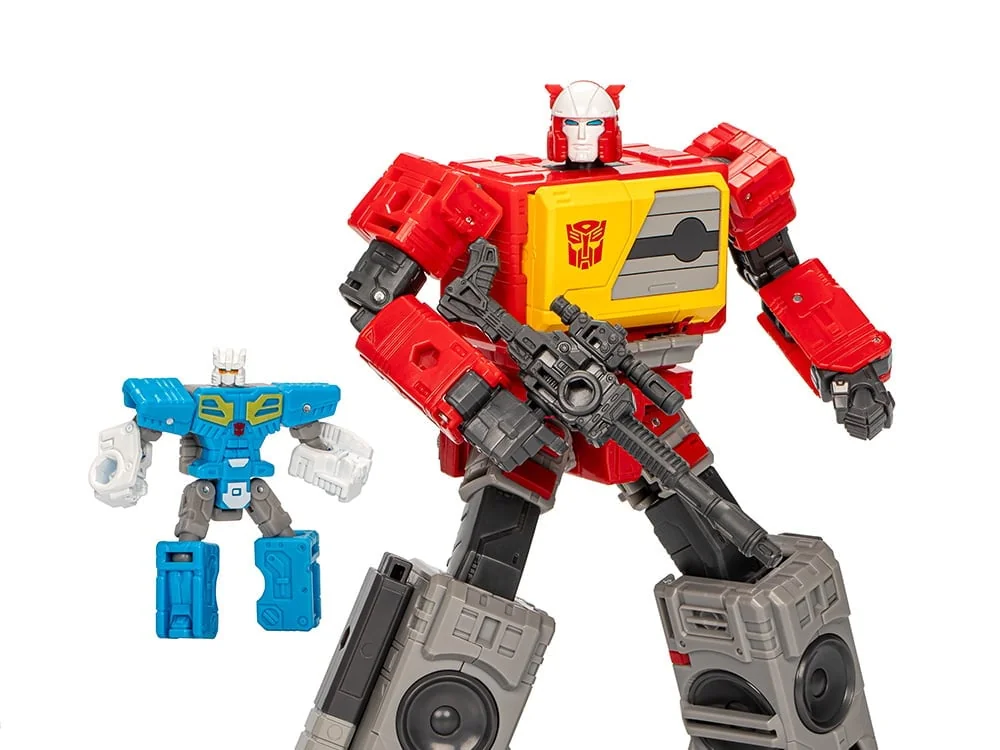
Blaster figures
Some links are affiliate links. We may earn a commission at no extra cost to you.