Autobot
Mirage
Autobot Spy
"Looks can be deceiving."
An aristocratic, reluctant soldier who is a superb spy and marksman but questions the Autobots' violent methods, quietly hopes both sides can simply get along, and is therefore suspected by his own comrades of Decepticon sympathies.
FactionAutobot
Alt-modeLigier JS11 F1 race car
Debut1984 . S01E02
VoiceFrank Welker
WeaponsElectro-disruptor (invisibility)
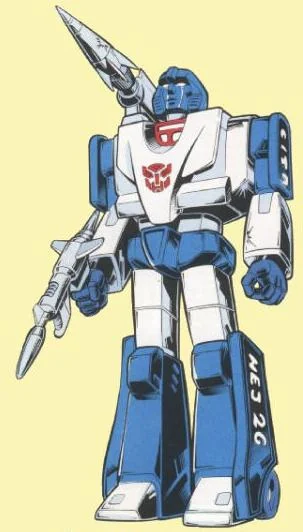
Image via TFWiki (Teletraan I: The Transformers Wiki), used under fan-archive fair use · source
Profile
Mirage is the Autobot who never wanted the job. Before the war he was Cybertronian old money, with an estate, high-priced friends, vintage energon and turbofox hunts, and the outbreak of hostilities dropped him into a unit of commoners he neither understood nor especially liked. His Hasbro tech spec is blunt about it: he is unsure of the Autobot cause and cannot be fully trusted. He is a capable fighter and a better intelligence gatherer, an expert marksman with an armour-piercing rocket-dart hunting rifle, but he keeps suggesting that the sensible move is to leave Earth and go home.
On screen that doubt is his defining trait. In "More than Meets the Eye, Part 2" he proposes abandoning Earth to the Decepticons outright, and Optimus Prime shuts him down. It also nearly destroys him in "Traitor", where Cliffjumper reads his scouting record as evidence of treason. Mirage makes it worse by going off-book to frame the Decepticons for stealing the Insecticons' energon, is caught red-handed with the cubes, then implanted with one of Bombshell's cerebro-shells and used to walk the Autobots into an ambush. The truth comes out and Cliffjumper apologises, but the suspicion never entirely lifts.
When he commits, he is decisive. He cloaks aboard the Decepticon star cruiser in "More than Meets the Eye, Part 3" and shoots out its controls; he plants two dominator disks on Constructicons at once in "The Core"; and in "Desertion of the Dinobots, Part 1" he lifts Megatron's fusion cannon straight off his arm. He is also the Autobot the cybertonium shortage humiliates, when his invisibility degrades into a mild colour change.
Abilities and weaknesses
Mirage's electro-disrupter casts illusions that alter his apparent physical placement and appearance for up to about six minutes, which the cartoon almost always renders as outright invisibility; he is also an expert marksman with an armour-piercing rocket-dart hunting rifle, carries a shoulder missile, and is rated a more effective intelligence gatherer than combatant. The limits are real: the illusion has a time cap, it does not make him bulletproof, and it fails outright when he is low on resources, as in "Desertion of the Dinobots, Part 1", where cybertonium depletion reduces his invisibility to a slight change of colour and he is blasted into a wall by Thundercracker. His biggest weakness is not technical but temperamental, since the tech spec itself says he cannot be fully trusted.
Tech specs
Strength
5/10
Intelligence
8/10
Speed
7/10
Endurance
6/10
Rank
6/10
Courage
5/10
Firepower
7/10
Skill
8/10
Key appearances
| Episode | Why it matters |
|---|---|
| More than Meets the Eye, Part 3 | Cloaks aboard the Decepticon star cruiser and shoots out its controls, then parasails clear as the ship crashes into the ocean. |
| Traitor | The definitive Mirage story: falsely accused by Cliffjumper, then brainwashed by a cerebro-shell and forced to lead the Autobots into a genuine ambush. |
| The Core | Turns invisible after Devastator blasts him off a cliff, helps Sunstreaker bring the combiner down, then plants two dominator disks at once. |
| Desertion of the Dinobots, Part 1 | Steals Megatron's fusion cannon off his arm, and later discovers his invisibility has failed thanks to cybertonium depletion. |
| Masquerade | Poses as Drag Strip among the fake Stunticons and, uniquely for the cartoon, uses an actual hologram to help fake a Menasor. |
Relationships
- Cliffjumper: the friction that defines both characters, from Cliffjumper's grudging praise in "More than Meets the Eye, Part 2" to his public accusation of treason in "Traitor".
- Hound: his natural partner on infiltration work, the two combining invisibility and holograms to break into the antimatter lab in "Roll for It" and the New York sewers in "City of Steel".
- Optimus Prime: the leader he chose for a reason and repeatedly disagrees with, most openly when he proposes abandoning Earth.
- Ravage: his recurring Marvel opponent, who tears his left arm off in "The Last Stand" and finally provokes him into fighting properly.
Comics versus cartoon
The cartoon reduces his powers to plain invisibility and keeps his disloyalty as a running suspicion that is always ultimately disproved, most explicitly in "Traitor". Marvel takes the doubt seriously, opening with Mirage trying to reason with Ravage as a "brother Transformer" and openly believing he has picked the wrong side, and only converting him into a committed soldier after Ravage rips his arm off.
Fate
In the cartoon his last significant appearance is "Masquerade" near the end of season two, after which he is written out with the rest of the 1984 cast; a cut storyboard sequence from The Transformers: The Movie had Megatron blast him during the Battle of Autobot City, but the scene never made the finished film. In Marvel he is blown apart by Octane in the Arctic, repaired, and then destroyed for good by the Underbase-empowered Starscream in "Dark Star".
Trivia
- Mirage transforms into a Ligier JS11 Formula One car, a model already superseded in real racing years before the cartoon debuted; the real car's Gitanes tobacco livery was altered to read "Citanes" because of laws on tobacco advertising on children's toys.
- Two conflicting bios exist. Bob Budiansky's original gave him an electro-disrupter that scrambles other Transformers' senses, while the cartoon production bible describes a photon disrupter granting real invisibility and holograms. Most classic media followed the second version, and the cartoon settled on invisibility, likely to avoid duplicating Hound's hologram power.
- An early character model sheet had the split "Citanes" logos drawn onto his robot-mode arms and legs, with a note telling animators to omit them for pre-Earth scenes; the final model dropped them entirely, though the unfinalised version was later reprinted in The Ark books.
- In 1984 Mirage was the most common Autobot Car at his price point, packed two per case for much of the year to fill out a twelve-slot case containing only eleven different figures.
- His mould was subsequently lost or damaged, making him one of only two regular-retail 1984 toys never reissued in any capacity, the other being the mispacked "Bumper".
Contested
Where the cartoon, the Marvel comics and the toy bios disagree, or where a popular claim does not hold up. We record these rather than smoothing them over.
- Hologram projection versus true invisibility: the packaged tech spec describes sensory illusions, the production bible describes real light-bending holograms, and the cartoon almost exclusively shows invisibility.
- Whether Mirage died at Autobot City. Peter Chung's first-draft storyboard explicitly shows Megatron's blast killing him, but the finished film only uses an ambiguous long shot.
- The Marvel colouring books misread the tech spec phrase about casting discrete packets of electrical charges and drew him hurling destructive balls of electricity, a power he has nowhere else.
Mirage figures
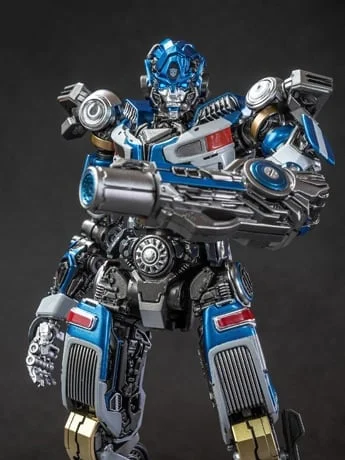
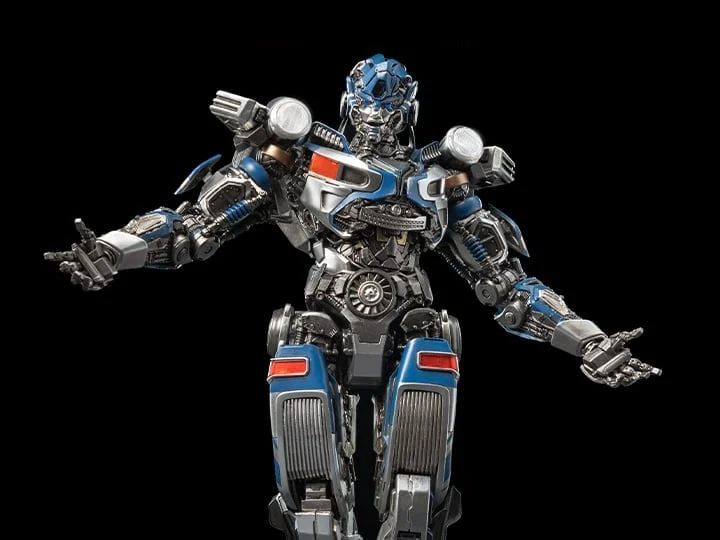
Some links are affiliate links. We may earn a commission at no extra cost to you.